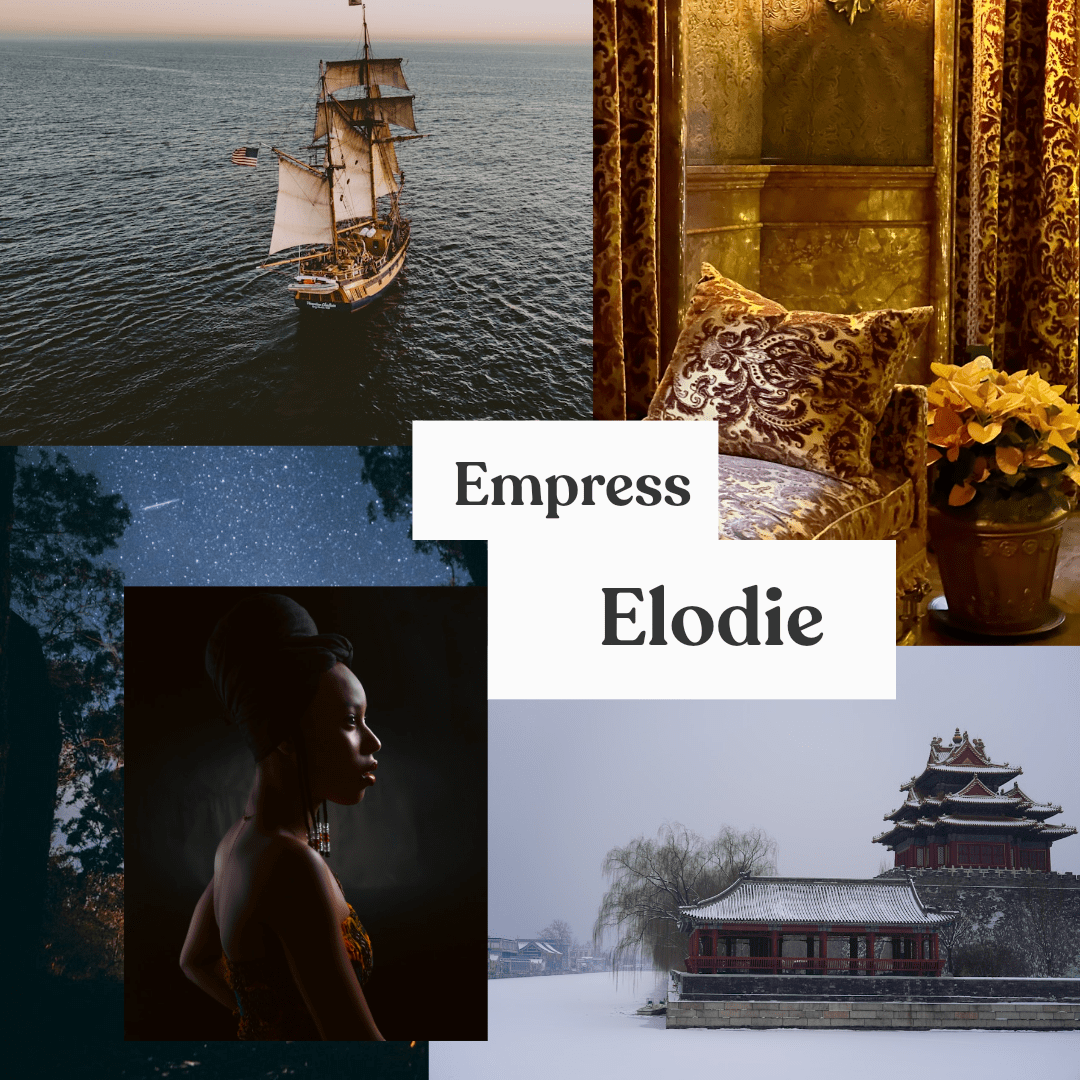
June Blog – The Tragedy of Elodie
Empress Elodie was probably one of the most frustrating characters to read. While she wasn’t frustrating to write, that was only because I knew what her life looked like before her tragic end. I knew who she was. Her fierce independent spirit. Her thirst for adventure. Her deep and enduring relationship with her family, especially her brother, who never stopped looking for her after she disappeared with Wenbo—a man he never trusted. Elodie’s family mourned her disappearance deeply, but because they are all dead by the time of the main story, we never get to see this. To explore their vivacity and warmth. That really upset me.
So I wanted to dedicate this blog post to her. And do know that Elodie’s family is not gone from the story! Because I enjoyed fleshing out her family tree so much, I realized that they had to still be in Eleison. They were too big and important not to be. And they are—as the Marcel Merchants Lark and Clio learn about in Of Wildflowers and Rainfall. Please enjoy that expansion of the story when it comes out! They’ll also appear in the holiday spin-off I’m working on, and hopefully in the prequal I’d love to write starring Elodie herself.
But I think we have to start with the overt problem some of you might have noticed. As an author, it’s our responsibility to consider what we present to an audience and how we depict our characters. And when our blindspots prevail, to seek out other eyes and correct our ignorances. So I very obviously noticed that I had depicted my Black female character, the only one to appear in the novel at that time, as having no agency. Not even a line of dialogue that is her own. She is asleep for the entirety of the time we know her. Is it a tragedy, and presented as such? Yeah. But does that change the fact that I put her in that position knowingly? No.
I’ll admit that there was a moment where I considered just . . . making Elodie white. It would kind of erase my problem and protect me from criticism. But Elodie was a character who appeared _so _clearly in my mind. She knew who she was from the beginning. And it would be disingenuous to go against what she and I both knew to be true by just whitewashing her. I love Elodie exactly as she is—but I have the privilege of knowing her. I also sat at my laptop forever wondering if I could avoid writing in her death. I just didn’t see how I could do so without sacrificing the meaning of that death. The recognition that Michalis had orchestrated the same fate for another that he had so condemned when it happened to him. This fate being a death no one mourns.
This may be a spoiler, so skip ahead to the next paragraph if you haven’t read Of Partings and Moonlight and Of Hymns and Eternity: it is Elodie that Michalis asked Jin to speak to. Of all the dead in the world, he wanted to make amends with her. To ask her if she was ever happy. To learn who she was, because he, like everyone else, had never tried to do so.
Elodie had to be an unknown. She couldn’t have a vivid past to function in the story. Because no one in the story—not even Wenbo—really cared to know her. As the reader, I think that’s a lot tougher to reconcile with, because _we _care. _We _want to know. _We _are not callous gods. Elodie was human, painfully so, and so we rightfully see the truth of her: she was a body in a gilded bed, tended to like a corpse and never referred to by name by other gods, only to be used and tossed away. I don’t blame any reader for being mad at that. Honestly, I’d be truly glad to hear you were. That she had an impact on you and you hate the fact that she was treated that way, especially as a Black woman.
So let me tell you a little about Elodie, Empress of Cantata. The woman who lived. Elodie’s father was a man named Marcel, who started a merchant’s business with his family in the southern corner of Eleison. At that time, trade and communication between villages was minimal and roads were not very developed or safe. Marcel’s enterprising paid off, and his business began to grow and grow. His five children grew up with it, and became invaluable members of the family business. Elodie was the second youngest child, and her responsibility was the nascent sea routes. Always close with her family, she had this inexhaustible independence only someone with a warm hearth always waiting could safely have.
Elodie was closest to her elder brother Nico. The two had an ongoing competition: to find the greatest sight in the world. When she came of age and got her own ship and crew to command, Elodie really never looked back. She loved life on the sea and the thrill of discovery, was an avid and adept communicator and could make trades with ease. She’s one of the few characters in the story who experience the world beyond Eleison. It may be because that that her family was never religious. As Marcel’s business grew, so too did their home base, an estate in the port town that became more and more a social hub. It would later be named Port Marcel after the man who made it grow so. I love the image of Elodie and Nico coming home for family dinners smelling of sea salt and the sun and spinning tales to their family about their adventures . . . only embellishing them a little.
The nature of her work makes her mature and confident, but she definitely has a more reckless streak than her siblings, who stick to what’s responsible. She’s quick-witted, especially when Nico is around, and the two share private jokes and ripostes that have their siblings rolling their eyes. Elodie’s an optimist—she always believes in the good of the world and her own ability to bring about the future she desires. Nico is a little bit more realistic and can keep her grounded, but he also enjoys adventure so he’s not the one ever going to hold her back.
Nico’s descendants still exist in Eleison, through Simon, who you’ll meet in Of Wildflowers and Rainfall. Simon definitely grew up hearing stories of his missing relative, but at that point was a bit tired of it and could never get a grasp on the clear story anyway. Nico is himself an interesting character. I don’t want to talk too much about Elodie and Wenbo’s relationship, as I plan to write about it fully and want to avoid spoilers. But when Elodie disappeared with Wenbo, Nico’s entire life path changed. We know she went to Cantata, but we really don’t know much else, and I’ll keep it at that.
But what I will share is what I wrote in my notes about Nico and the family that lost Elodie: “they all knew Elodie would never miss the marriage of her sister, the birth of Nico’s child, or the illness of her father. Her not being at his deathbed was the final sign—Elodie was truly gone.” Nico never stopped searching for her. He spent his entire life traveling across Eleison and beyond in the hopes of catching a sign of her. But he never did. Not a single clue. The madness of that anguish trickled down through his family, and it hurts to know he never received an ounce of closure. It hurts to know that Elodie never had the chance to console him, or the choice to return home. And it hurts to know that Elodie’s adventurous spirit was not at all at odds with her love of her family, and her independence was never bridled by their closeness. It hurts because she had something most people don’t.
I hope this post shows a couple of things. The first and most selfish thing is, I hope it shows I didn’t just write Elodie in to die meaninglessly. I know it can feel that way because that was kind of the point—gods don’t care—but she was as important to me as anyone else. The second thing is, I hope you enjoy getting to meet her! I was sad to be holding on to all these images and moments when readers got nothing! I’d be happy to do a deep dive on any of the other characters you were interested in—as I do so much prep work before writing! It also makes it so tempting to write more, and I’ll say things to myself like “wait we didn’t get a full explanation of this or get to learn about that!”. Believe me when I say I want to write it all—especially when that character has so much still to say, like Empress Elodie does.